Loan Against Property: The Fast & Definitive Valuation Guide
The most comprehensive, 5000-word guide on the internet for securing a Loan Against Property (LAP). Learn how lenders determine your Loan-to-Value (LTV), conduct technical verification, and how you can maximize your approved loan amount.
Looking for a fast loan on your property?
I totally understand how frustrating it can be.
You own a valuable piece of real estate. You need cash fast to expand your business or cover an emergency.
But when you go to the bank, the process feels like a black box.
Here is the honest truth:
The exact amount of money a bank will lend you directly depends on one crucial, non-negotiable factor.
Your property valuation.
In this incredibly comprehensive, step-by-step guide, I am going to break down exactly how lenders look at your real estate portfolio.
We will uncover the secrets of Legal & Technical verification.
We will decode how Loan-to-Value (LTV) ratios actually work.
And I'll even reveal the state-specific guidance values you must know.
Let's dive right in.
The Golden Rule of LAP
The bank is not lending money based on what you think your house is worth. They are lending money based on what they can recover if you default. Your property's immediate liquid market value is the only metric that truly matters.
By the way, want to see your entire portfolio's real-time net worth before applying?
Check out the Assett platform to track your properties effortlessly. Or read our ultimate guide to real estate net worth tracking.
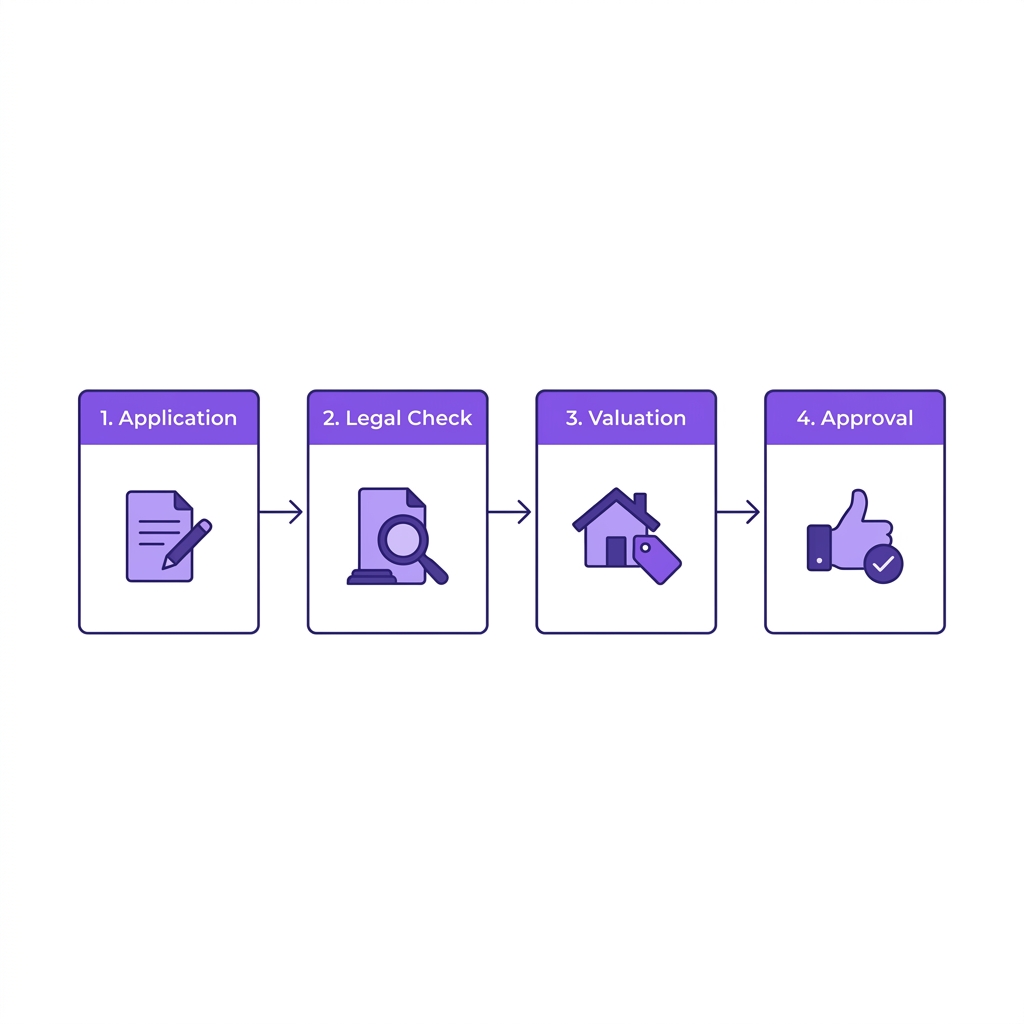
1. The Step-by-Step LAP Valuation Process
When you apply for a Loan Against Property, banks do not just accept the property value you write on the application form.
Not even close.
They follow a rigorous, multi-tiered Legal and Technical Verification process to protect their capital.
Understanding this process step-by-step will give you a massive advantage.
Why?
Because you can preemptively resolve issues before the bank's appraiser even knocks on your door.
- Application & Deep Documentation Analysis
The process begins the moment you hand over your property documents.
The bank requires an unbroken chain of title deeds. If the property changed hands five times in the last thirty years, they want the original sale deeds for all five transactions.
They will cross-reference your approved building plan against the actual constructed area.
Their goal? To identify illegal floors or unauthorized extensions.
- Legal Verification & Title Search
Next, the bank forwards your documents to an empaneled legal firm.
These lawyers physically visit the sub-registrar's office. They conduct a meticulous title search.
They generate an Encumbrance Certificate (EC) for the last 13 to 30 years. This guarantees the property is completely free from existing mortgages or pending litigation.
A disputed title is the single most common reason for a LAP application to be instantly rejected.
- Technical Verification (Physical Inspection)
Simultaneously, a certified appraiser physically visits your property.
This is the crucial "Technical Visit."
They check the structural integrity, the age of the construction, and the quality of materials. They measure the exact carpet area.
For older buildings (20+ years old), the appraiser will heavily depreciate the building cost. They will rely almost entirely on the intrinsic value of the land beneath it.
- Market Analysis & Fair Market Value
Finally, the appraiser determines the "Fair Market Value" (FMV) of the asset.
How?
By pulling data on recent, highly comparable property sales in your immediate neighborhood.
They factor in your property's proximity to key infrastructure—metro stations, arterial highways, and top-tier schools.
2. Mastering the Loan-to-Value (LTV) Ratio
Here is one of the most misunderstood concepts in real estate finance:
If your property is officially valued at ₹2 Crores by the bank's appraiser, the bank will NOT lend you ₹2 Crores.
In reality, banks use the Loan-to-Value (LTV) ratio as a critical risk-mitigation buffer.
The LTV is the exact percentage of the property's appraised value that the bank is willing to lend.
If real estate prices crash tomorrow, the bank wants to ensure they can still recover their principal.
Therefore, lenders typically offer a LAP amount ranging from 50% to 80% of the final market value.
But why is there such a massive range?
It comes down to your Asset Class.
Self-Occupied Residential Property (LTV: 75% - 80%)
Banks view the home you currently live in as the safest possible collateral.
The psychological attachment you have to your primary residence means you will go to extreme lengths to avoid defaulting.
Because the risk is statistically lowest here, banks reward you with the highest LTVs in the industry.
Commercial Property (LTV: 60% - 70%)
Commercial properties are viewed as moderately risky.
Their value is heavily tied to business cycles. During an economic downturn, commercial real estate suffers from plunging rental yields and high vacancy rates.
Therefore, banks cap the LTV at roughly 65% to protect themselves.
Vacant Land / Industrial Plots (LTV: 50% - 55%)
Vacant residential plots and industrial plots carry the highest risk profile.
They are notoriously difficult to sell quickly. They are also prone to illegal encroachment.
Consequently, banks will rarely lend more than half of the property's appraised value.
3. The Five Professional Valuation Methods
When the technical appraiser sits down to calculate your final number, they don't guess.
They rely on five established industry frameworks.
The method they choose depends entirely on the nature of your property.
- The Sales Comparison Method: This is the universal standard for residential apartments. The evaluator pulls registry data for 3 to 5 similar properties in your locality that were sold in the last 6 months.
- The Investment Method: Used primarily for commercial real estate. The appraiser calculates the property's value based on the capitalization rate (Cap Rate) of its current rental yield.
- The Contractor's Method: Employed when the property is highly unique and lacks comparable sales data. It calculates exactly how much it would cost to construct the exact same building from scratch today.
- The Profits Method: Reserved for highly specialized commercial properties like hotels or cinemas. The appraiser analyzes the audited gross profit of the business to derive the asset value.
- The Residual Method: Applied to properties with immense development potential. It calculates the final value of a potential future building, subtracts construction costs, and attributes the "residual" value to your land.
4. Detailed LAP Eligibility Criteria & Documentation
Property valuation is only half the battle.
To secure a Loan Against Property, you must prove to the lender that you have the financial capacity to repay the monthly EMIs.
And you have to prove it for the next 10 to 15 years.
In India, lenders strictly categorize applicants into two distinct profiles:
- Salaried Individuals
- Self-Employed Professionals
The scrutiny for each profile is vastly different. Why? Because business incomes are inherently more volatile than fixed monthly salaries.
Core Eligibility Requirements
- Age Limits The minimum age to apply is generally 21 years. The maximum age at loan maturity is strictly capped at 60-65 years. If you are 55 years old applying for a 15-year loan, the bank will reject it or restrict the tenure to 5 years.
- Credit Score (CIBIL) A CIBIL score of 700 or above is considered the bare minimum. But to unlock the lowest interest rates? You need a CIBIL score of 750+. If your score is below 650, most tier-1 banks will reject your application outright.
- Minimum Income Thresholds Most lenders require a minimum net monthly income of ₹25,000 for salaried individuals. For self-employed individuals, the minimum required Gross Annual Receipt (GAR) is usually ₹3 Lakhs, backed by audited financials.
Exhaustive Documentation Checklist
The documentation phase is where most loan applications stall.
Preparing this exhaustive list beforehand can cut your loan processing time from 4 weeks down to just 7 days.
For Salaried Individuals
Employed with MNCs or reputed private companies.
- • KYC: PAN Card, Aadhaar Card.
- • Income: Latest 3 to 6 months' salary slips.
- • Tax: Form 16 for the last 2 consecutive years.
- • Bank: Last 6 months' salary account statements.
- • Employment: Offer letter or employee ID card.
For Self-Employed
Doctors, CAs, traders, and SME owners.
- • KYC: Individual PAN, Company PAN, Aadhaar.
- • Business: GST Registration or Trade License.
- • Financials: Audited Balance Sheet & P&L for 3 years.
- • Tax: ITR for the last 3 years with computation.
- • Bank: Last 12 months' current account statements.
In addition to the above, Property Documents are universally required.
This includes the original Title Deed, previous chain of agreements, latest property tax receipts, and approved municipal building plans.
5. Navigating LAP Tax Benefits (Section 24 & Section 37)
There is a widespread myth about Loans Against Property.
Many people believe they offer the exact same tax deductions as standard Home Loans.
This is completely false.
The tax treatment of a LAP in India is determined entirely by the end-use of the funds. It is NOT determined by the fact that property was pledged as collateral.
Section 80C Does Not Apply
Unlike a standard home loan, the principal repayment of a Loan Against Property is never eligible for any tax deductions. Period.
However, it gets better:
You CAN claim massive tax deductions on the interest component of your EMI. But you must use the funds for specific, government-approved purposes.
Scenario A: Using Funds for Business Purposes (Section 37)
Are you a self-employed professional? Do you plan to utilize the LAP funds exclusively to expand your business?
If so, you unlock the best tax benefits available.
- Under Section 37(1) of the Income Tax Act, the entire interest paid on the loan can be claimed as a legitimate "Business Expenditure."
- All associated loan processing fees and legal appraisal fees can also be written off.
- This substantially lowers your corporate tax liability.
Scenario B: Using Funds for Residential Property (Section 24)
What if you take a Loan Against Property to fund the purchase or renovation of another residential property?
In this specific case, the Income Tax Act treats the interest component similarly to a home loan.
- Under Section 24(b), you can claim a tax deduction on the interest paid.
- If the new property is self-occupied, the maximum deduction is capped at ₹2 Lakhs per year.
- If the new property is rented out, you can potentially claim deductions on the entire interest amount against the rental income.
Scenario C: Using Funds for Personal Expenses
If you utilize the loan proceeds for personal reasons (like a wedding or a vacation), no tax exemptions are available whatsoever.
Crucial Documentation Requirement
To claim these tax benefits, you cannot simply tell the Income Tax Department how you used the funds. You must maintain an airtight, auditable paper trail. The burden of proof lies entirely on you.
6. Demystifying LAP Interest Rates & Repayment Tenures
Securing a high Loan-to-Value (LTV) is excellent.
But there's a catch.
If you lock yourself into an exorbitant interest rate, the compounding cost over a 15-year tenure will absolutely decimate your wealth.
LAP interest rates in India typically range from 8.50% to 14.00% per annum.
Fixed vs. Floating Rates
Floating Rates are linked to the RBI's Repo Rate. When the RBI cuts rates, your EMI goes down.
Fixed Rates remain constant. They shield you from inflation, but they are usually priced 1% to 2% higher. For a 15-year loan, floating rates are historically the mathematical winner.
The Role of Tenures
Unlike personal loans capped at 5 years, LAP tenures can stretch to 20 years.
A 20-year tenure dramatically lowers your monthly EMI. But it exponentially increases the total interest paid. Savvy borrowers opt for the longest tenure but aggressively pre-pay the principal.
7. Deep Dive: State-Specific Portals & Government Values
Land and property registration are fundamentally state subjects under the Indian Constitution.
Because of this, there is no centralized database for property values.
You MUST use state-specific portals to find your property's government baseline value (Circle Rate or Guidance Value).
Karnataka (Kaveri Online Services)
For properties in Bengaluru or anywhere in Karnataka, use the Kaveri online property valuation system.
- You can use the portal to check exact rates by selecting your District, Taluka, and Village.
- The system allows you to download the official Government value of land in Karnataka PDF. This is legally recognized by all banks.
Maharashtra (IGR Maharashtra)
In Maharashtra, banks heavily scrutinize the "Ready Reckoner Rate".
- The official IGR Maharashtra portal provides an interactive e-ASR tool.
- You can pinpoint the base rate of your exact survey number using a dedicated property valuation calculator Maharashtra.
Andhra Pradesh & Telangana (IGRS Portals)
To check the government land value here, visit their respective official IGRS portals.
- The portals feature a "Market Value Search" tool. The basic value register for your specific survey number is publicly available.
8. Ultimate Frequently Asked Questions (FAQs)
What happens if I default on a LAP?
Because a LAP is a secured loan, defaulting carries severe consequences. If you fail to pay EMIs for 90 days, the account becomes an NPA. The bank will initiate legal proceedings under the SARFAESI Act to seize and auction your property.
Can I get a Loan Against Agricultural Property?
Generally, no. Under Indian banking regulations, standard commercial banks do not accept agricultural land as collateral for standard LAP products. You would need specialized agricultural financing products.
Is it better to take a LAP or a Personal Loan?
If you need a large sum (above ₹15 Lakhs) and have a longer repayment horizon, a LAP is mathematically superior due to lower interest rates. If you need funds urgently within 48 hours, a personal loan is faster.
Ready to unlock your property wealth?
Get an instant, accurate picture of your real estate portfolio's true market value and discover exactly how much loan you qualify for.
Calculate Your Property Value